
Burning Man is meticulous about removing every physical trace from the playa. But what about the cultural traces we keep bringing in with us?
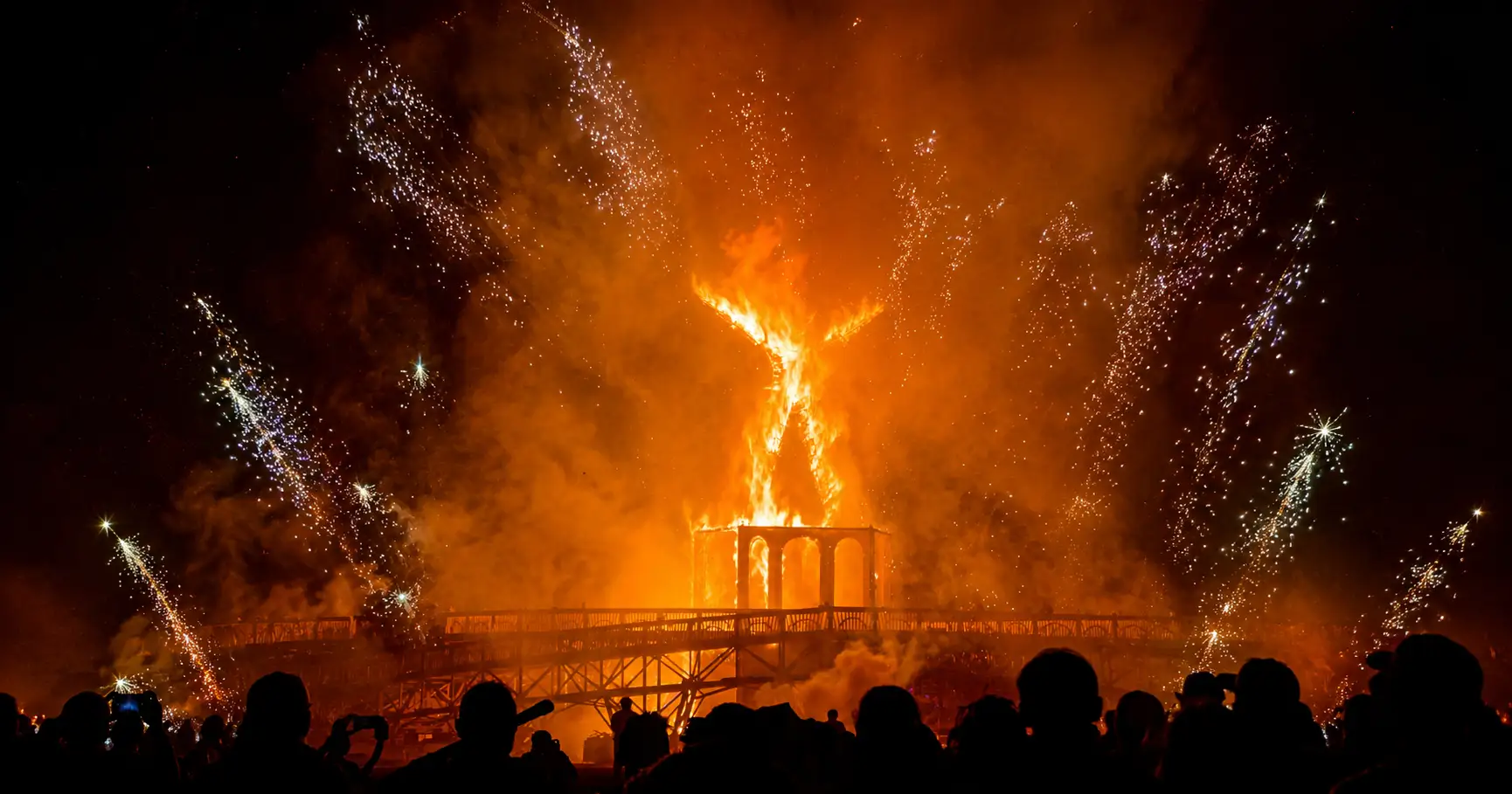
I had heard about Burning Man for seven or eight years before I finally went. Like most people hearing about it from the outside, I knew the mythology first: a temporary city in the Nevada desert, built largely by its participants, supposedly without conventional commerce or spectators, and held together by ten principles. Radical Inclusion. Gifting. Decommodification. Radical Self-reliance. Radical Self-expression. Communal Effort. Civic Responsibility. Leaving No Trace. Participation. Immediacy.
The principles are beautiful. Which is exactly why some of what Burning Man is becoming feels increasingly contradictory. I have only been once. I cannot tell you what the playa felt like twenty years ago, and I am not interested in pretending I belong to some generation of Burners protecting the “real” Burning Man but perhaps being relatively new to it made something easier to notice.
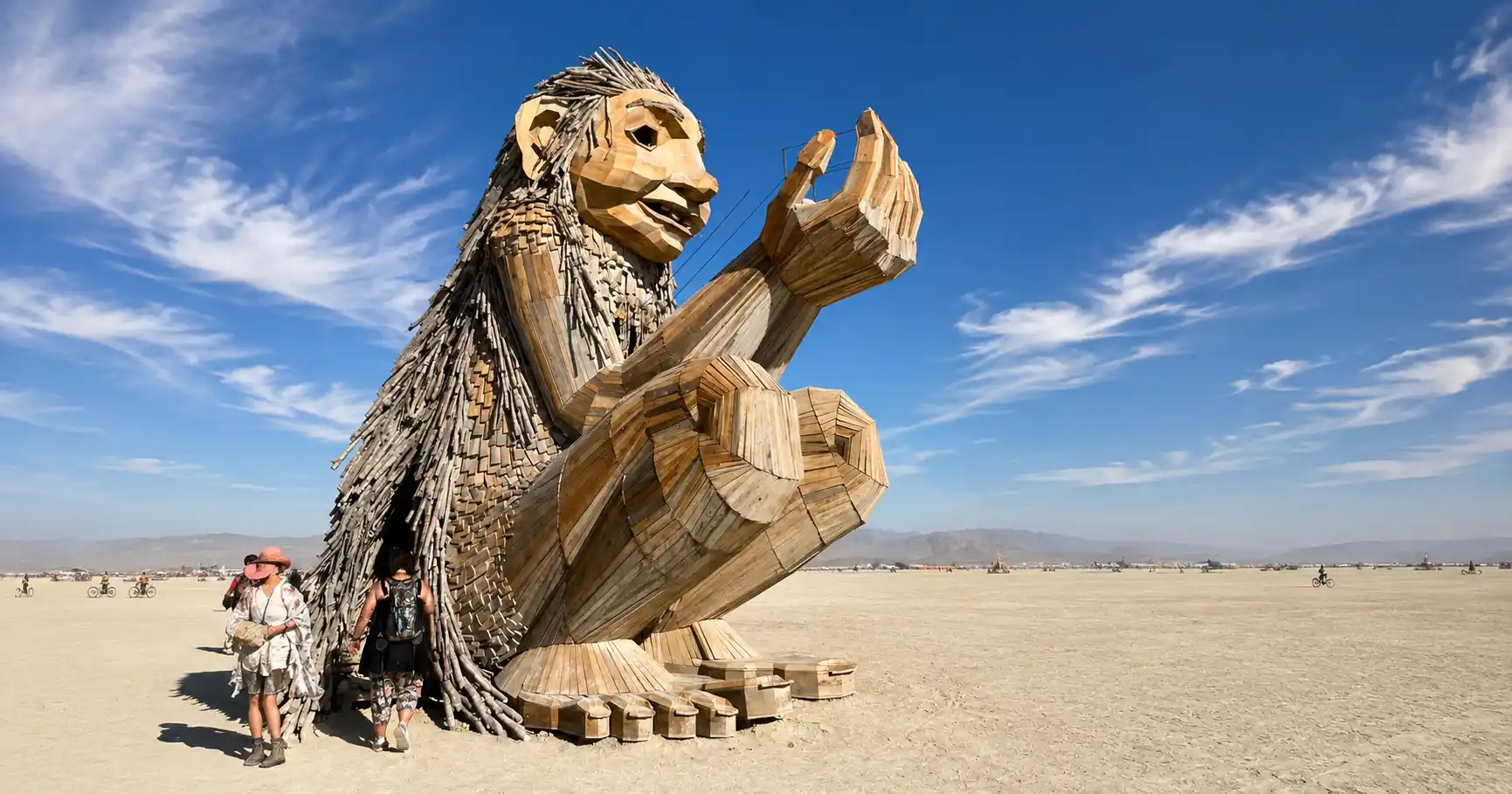
Before my first Burn, I deliberately did not watch too much. I did not study every artwork. I did not memorize every camp. I did not construct a DJ itinerary. So when I arrived, things genuinely appeared out of nowhere. I would cycle through the dust toward strange lights without knowing what I would find. Music would pull me in a direction. An enormous structure would suddenly emerge on the horizon. I discovered Burning Man while I was inside Burning Man.
That uncertainty was one of the most extraordinary parts of it. Watching Burning Man online, I keep wondering: How much of Burning Man can remain radical, immediate or surprising when we already know almost everything before arriving?
Radical Self-Expression, or a New Uniform?
Burning Man describes Radical Self-expression as something arising from the unique gifts of the individual. The important word here is individual and yet one of the supposedly most radically expressive places in the world has somehow developed one of the most recognizable aesthetics in the world. Goggles. Harnesses. Fur. Platform boots. Metallic bodysuits. Elaborate headpieces. Post-apocalyptic desert warrior. There is nothing wrong with dressing up. I did too.The contradiction begins when self-expression becomes so standardized that you can almost purchase a ready-made Burner identity before ever seeing the playa. Outfits are designed with photographs in mind. Photographs are planned around installations. Certain artworks become obligatory backdrops. Expression that was supposedly about the individual begins interacting with an audience thousands of kilometres away. At what point does Radical Self-expression become performance? And if it is performance, who exactly are we performing for?
Immediacy, With Spoilers
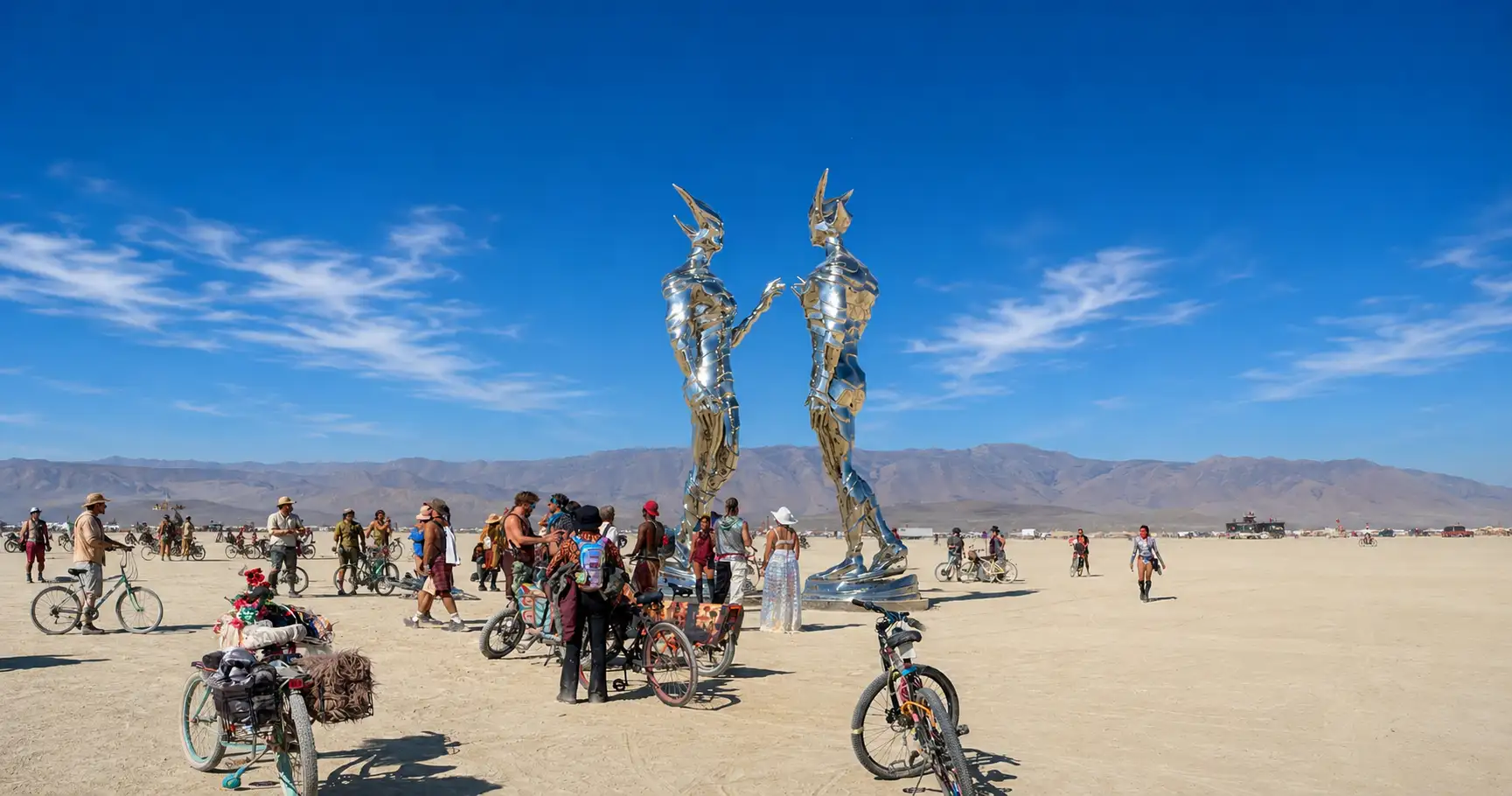
This may be Burning Man's biggest contradiction now. The principle of Immediacy is about direct experience. Yet increasingly, Burning Man begins long before you reach Black Rock City. Artwork is shown while being built, camp preparations are documented, DJ appearances circulate, unofficial lineups are shared, people announce where they will be, what they are building and what everyone should come and see. There may technically be no official Burning Man music lineup. Culturally, there absolutely are lineups. People plan their nights around DJs. They save schedules. They chase sets. They create lists of things they cannot miss.
There is nothing inherently wrong with knowing who is playing but something changes once you start approaching the playa through optimization. You stop wandering. You start scheduling. You stop encountering. You start locating.
Participation, But With Millions of Spectators
Burning Man has always insisted that there are no spectators. Everyone participates!! That idea is one of the things that made Burning Man interesting to me in the first place. The city exists because people create it. They build, cook, repair, gift, perform, help strangers, make art, create experiences but social media has quietly introduced an enormous spectator population into Burning Man. Millions of people who are nowhere near Nevada can watch the playa unfold almost in real time. And once an outside audience exists, some behaviour inevitably starts responding to that audience.
An artwork becomes content, an outfit becomes content, a sunrise becomes content, an experience becomes content, a photograph is no longer simply a memory. Sometimes the experience itself starts being arranged around producing the photograph. Burning Man says there are no spectators. The internet created millions of them.
Decommodification, but Mostly Inside the Fence
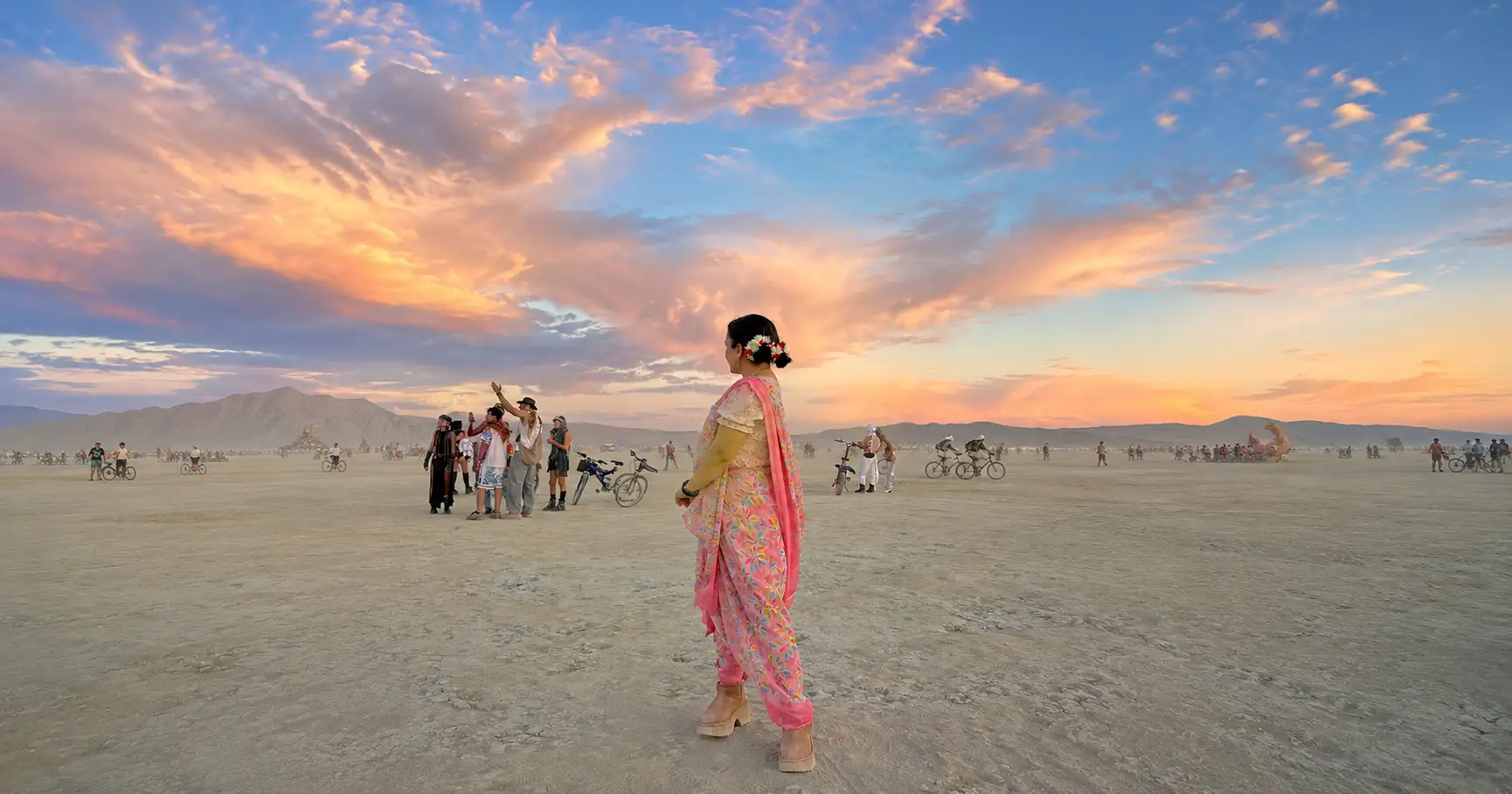
Burning Man famously rejects conventional commerce inside Black Rock City and yet there is now an enormous commercial ecosystem surrounding the supposedly decommodified experience.
Burner fashion, specialized desert gear, RV rentals, costume designers, professional camp services, transportation, equipment rentals, shopping lists long enough to equip a small expedition. Capitalism has created an entire marketplace around helping people temporarily escape capitalism.
But even this is not what interests me most. Commercial activity can at least be identified. What is much harder to identify is when the values and habits of the outside world quietly enter the culture itself. Which brings me to MOOP
Burners talk constantly about MOOP, Matter Out of Place. A piece of plastic, a bottle cap, a loose thread, anything left on the playa that should not be there, you notice it, you pick it up, you leave no trace. It is one of Burning Man's most CUTEST habits. But lately I keep wondering whether there is another kind of MOOP accumulating at Burning Man, Cultural MOOP!!
Maybe endless content production is MOOP, maybe influencer-style photoshoots are MOOP, maybe experiencing art primarily as a backdrop for ourselves is MOOP, maybe knowing every major installation before encountering it is MOOP, maybe arriving with a DJ itinerary optimized down to the hour is MOOP, maybe importing the habits of Instagram, consumer culture and status into the desert, then putting goggles on them, is MOOP. And perhaps the biggest MOOP of all is bringing the behaviours of the “default world” into Black Rock City while convincing ourselves that simply changing our clothes makes us radical.
Maybe Burning Man's hardest cleanup now is not what people leave behind after the event, maybe it is everything we bring with us, the performance, the audience, the algorithm, the need to document, the fear of missing whatever everyone else has already decided matters.
Burning Man is extremely good at picking MOOP off the playa but the cultural MOOP may be considerably harder to see.